





Assessment and optimization of carbon storage and combined EGR-CPG development from high-temperature natural gas reservoirs
Introduction
Coupling Carbon Capture and Storage (CCS) and geothermal energy extraction, using supercritical CO2 (ScCO2), can in principle enable permanent storage of CO2 in (sedimentary basin) geothermal reservoirs while simultaneously extracting heat energy that can be used to generate clean, i.e., CO2-emission-free, baseload or dispatchable power [1,2]. Supercritical CO2 shows better heat “mining” qualities than water under most conditions, in spite of its lower heat capacity, because of its higher fluid mobility (i.e., lower kinematic viscosity) and higher thermal expansion coefficient [3,4]. Both a high fluid mobility and a larger thermal expansion coefficient of ScCO2 result in a significant thermosiphon effect that reduces or eliminates parasitic pumping power requirements, otherwise needed to circulate and produce fluids in conventional hydrothermal systems [5].
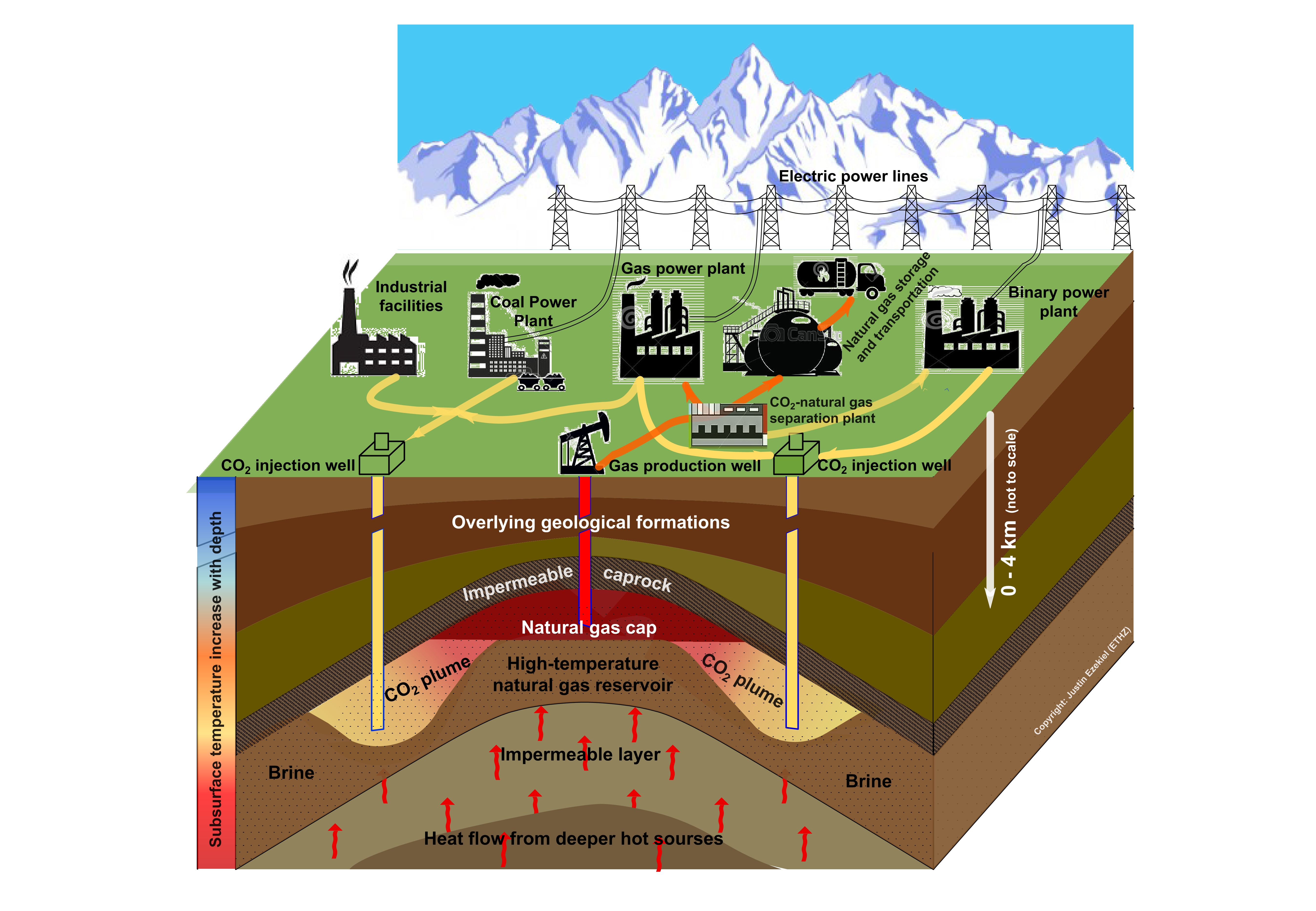
Furthermore, ScCO2 has also been used to enhance oil and gas recovery at partially depleted reservoirs over the last three decades, resulting in increased oil and gas production rates, while simultaneously, partially sequestering CO2 in the oil and gas reservoirs [6,7]. Against the backdrop of strongly fluctuating oil prices, the oil and gas industries are diversifying their business portfolio to include renewable energy options. The use, or conversion of partially or fully depleted gas reservoirs for CO2 storage and simultaneous co-production of geothermal energy and natural gas is likely to result in several opportunities, including (Figure 1): (i) enabling Carbon Capture Utilization and Storage (CCUS); (ii) high fluid (CO2) injectivity can increase the heat energy and natural gas extraction rate from the geothermal natural gas reservoir; (iii) improving the total amount of recoverable natural gas from the reservoir due to reservoir repressurization and/or pressure maintenance; (iv) use. of existing multidisciplinary datasets, surface facilities, and wells, adapted for CO2 storage and combined EGR-CPG purposes, thus reducing investment costs; (v) increase in the lifetime of the natural gas field and favorable postponement of the cleanup & abandonment stages of the field.
The studies presented here focus on the technical assessment and optimization of combined EGR-CPG applications in natural gas reservoirs, while storing all CO2 eventually. Studied are in particular the reservoir and surface power plant parameters that could influence CO2 storage and EGR-CPG system performance, natural gas recovery, and heat mining rates.