


GEG employs a variety of methods across computational, laboratory, and field investigations to advance geothermal energy research.
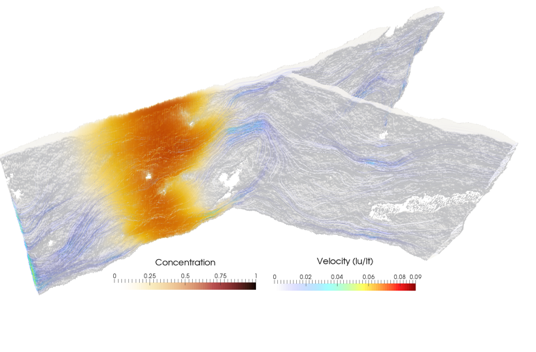
Simulations at the pore, lab, and field scales constitute part of our research work. Typically, they involve subsurface multiphase fluid flow, heat transfer, reactive transport, and geomechanics, with applications in such fields as geothermal energy, subsurface carbon dioxide storage, groundwater, oil/gas.
Pore-scale simulations improve our understanding of fundamental processes. Lab-scale simulations accompany our laboratory experiments. Simulations at the field scale help address concrete application-based questions.
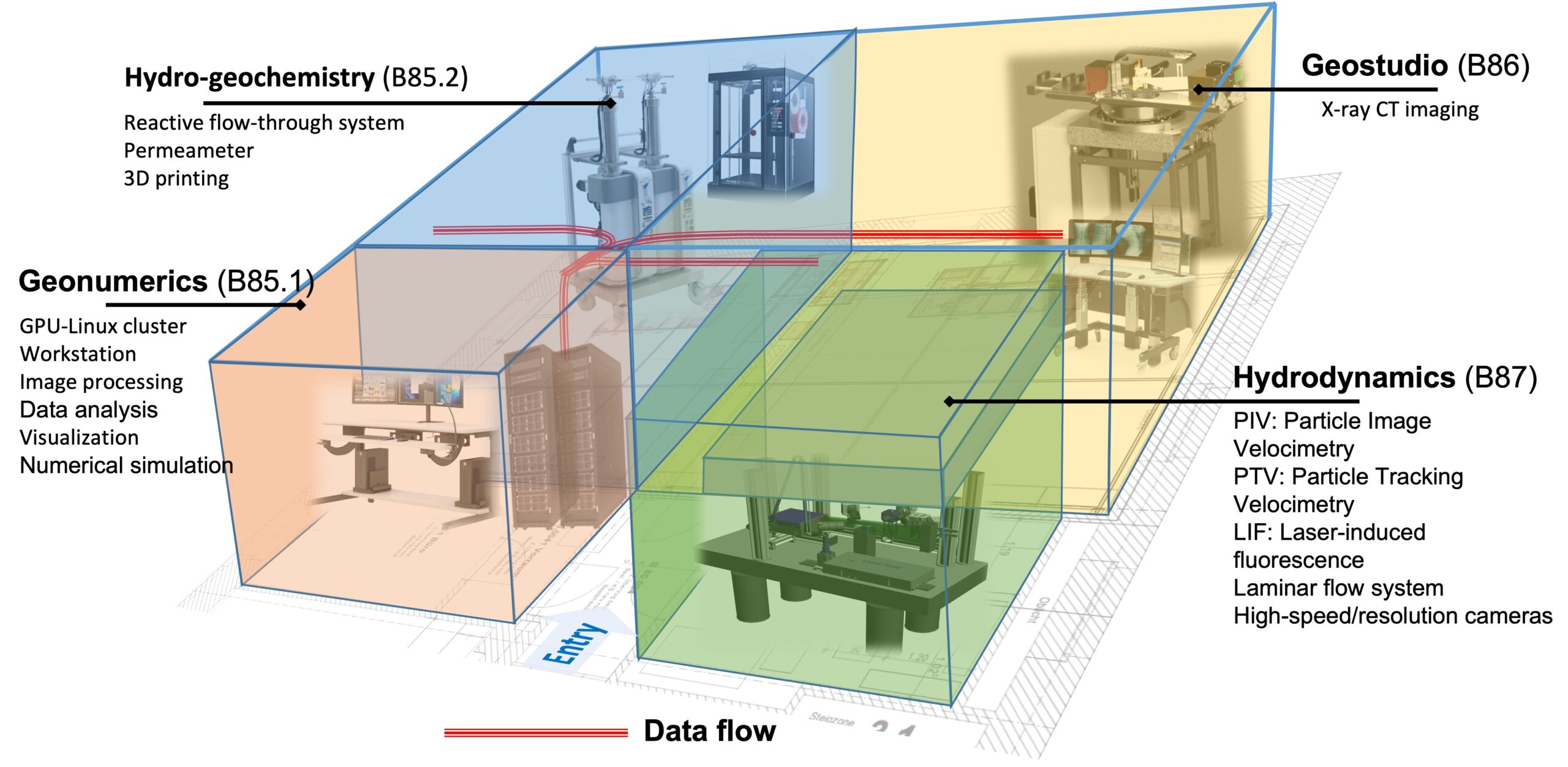
Our Geosystem REActive Transport (GREAT) Visualization Lab, a groundbreaking, worldwide unique laboratory, investigates reactive transport through a porous and/or fractured medium at sufficient spatial and temporal resolutions.
The GREAT Visualization Lab enables new research opportunities regarding reactive transport in porous and/or fractured media, as often encountered in geothermal, subsurface nuclear/CO2-waste storage, and groundwater systems as well as in many other (geo-)science and engineering fields.

Our recent field work concerns mainly two areas: