




Solute transport in 3D fractured reservoirs.

Example of a 2D fracture network. The pressure propagates along the pressure gradient from top to bottom.
Characterizing flow and transport through fracture networks in low permeable rocks is a key question for many energy- and groundwater-related applications. Various computational approaches have been developed to address these problems. One is the discrete fracture network approach (DFN), where the fractures are explicitly represented and form networks. An advantage of using DFNs is that it is possible to account for many different transport phenomena in fractured rock. Flow and transport can be explicitly linked to network characteristics such as fracture (1) density, (2) size, (3) orientation, (4) distribution and (5) aperture.
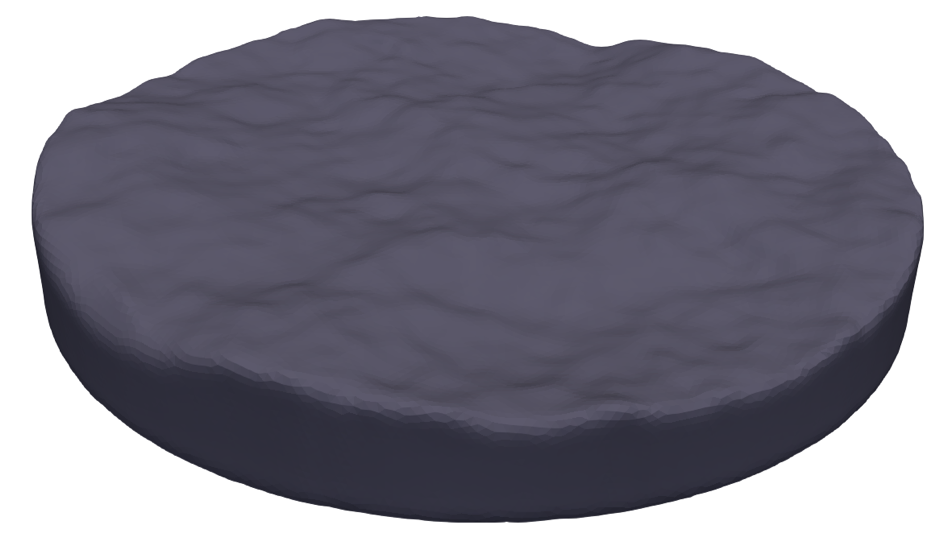
Fractures of all scales are characterized by two opposite rock surfaces with variable surface roughness and aperture. Due to the variable roughness, the local aperture of these walls is heterogeneous and promotes the formation of channels and barriers within fracture planes. This heterogeneity has a significant effect on flow and transport within fractures.

In this project, we perform numerical simulations in order to increase our understanding of the above-mentioned processes. Furthermore, we aim to find simplifications for the applied methods so that the modeling performance improves. Generic discrete fracture networks are generated based on above-mentioned network characteristics.
Numerical simulations of flow and transport in such heterogeneous model domains are computationally demanding, particularly if multiple realizations need to be performed. To optimize that we only consider large fractures explicitly because they dominate flow and transport. Small fractures are accounted for using effective permeability models.