

Plasma Pulse Geo-Drilling (PPGD)
Co-Principal Investigators
Prof. em. Hans-Olivier Schiegg, SwissGeoPower
Period:
July 2018-July2023
Related Projects
Innosuisse Flagship AGIS-CH
Researchers
Dr. Mohamed Ezzat, ETH Zurich
Dr. Daniel Vogler, ETH ZurichDr. Benjamin Adams, ETH Zurich
Dr. Edoardo Rossi, ETH Zurich
Dip.-Ing. Jascha Börner, Fraunhofer IEG
Dipl.-Ing. Volker Wittig, Fraunhofer IEG
Institutions




Grant Nr. 28305.1 PFIW-IW
Motivation
Geothermal energy is in principle a limitless energy resource that exists everywhere and is available all hours throughout the year. However, generating electricity out of the geothermal resource, employing what is the so-called enhanced and advanced geothermal systems, requires access to the deep, the typically, crystalline basement, rock formation, that exhibits a temperature of 150 C or more. For instance, in most regions in Europe, such temperature exists at depths larger than 5 km as the geothermal gradient temperature is around 35 C/km or less. Unfortunately, the conventional mechanical rotary drilling is way too expensive to enable economical geothermal energy extraction from deep crystalline rocks, due to the energy requirement and significant drill bit wear, which caused long tripping time to exchange the worn drill bit. To reduce deep geothermal drilling costs, novel, typically contactless, drilling technologies are required, such as Plasma-Pulse Geo-Drilling (PPGD).
Background information
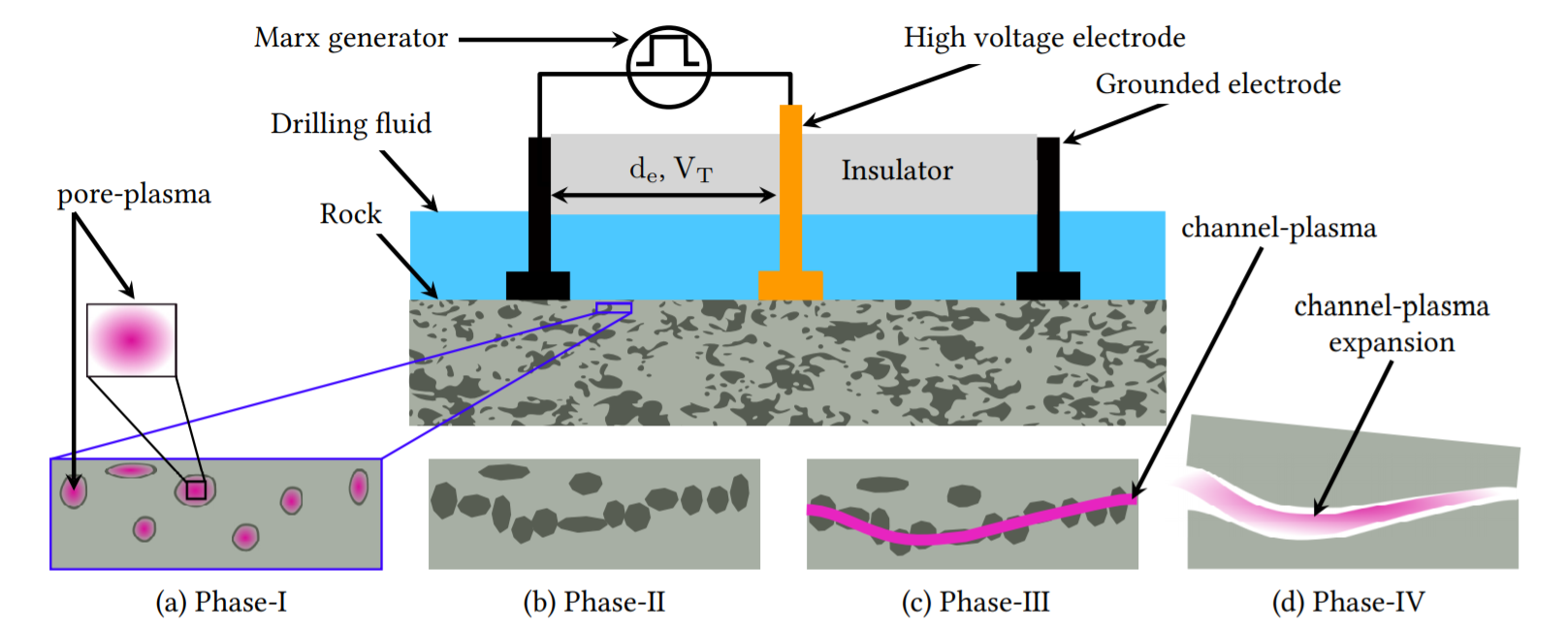
PPGD uses high voltage impulses (>200 kV) with short rise times (< 0.5 us) to fracture the rock without any mechanical abrasion. Two electrodes transmit these impulses to the rock surface, which induce internal electric discharge inside the rock bulk, forming a plasma channel, increases the tensile pressure, and the rock to fracture eventually, as shown in Figure (1). Consequently, PPGD eliminates the mechanical abrasion and the common moving parts in the traditional mechanical rotary drilling, such as drilling string. This absence of mechanical abrasion elongates the bit lifetime and shortens the tripping time significantly, which reduces the drilling cost. In this project, we perform numerical modeling and lab experiments to understand the physics underline the Plasma Pulse Geo Drilling and examine its viability under deep wellbore conditions of 5 km, i.e., temperatures up to 150 C and pressure up to 150 MPa.
Methodology
1. Numerical modeling
Here, we perform plasma, electrostatic and thermomechanical modeling to understand the rock fracture on the pore-scale using the PPGD. Therefore, we can investigate the key characteristics of the rock and optimize the operating condition. All models are based on the Multiphysics simulator, MOOSE Framework.
Repositories
- Simulating pore impact on PPGD
- Simulating plasma formation in pores
- Electropulse Stimulation Modeling
2. Lab Experiments
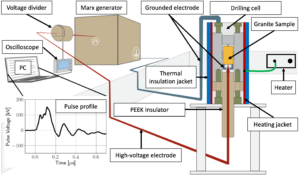
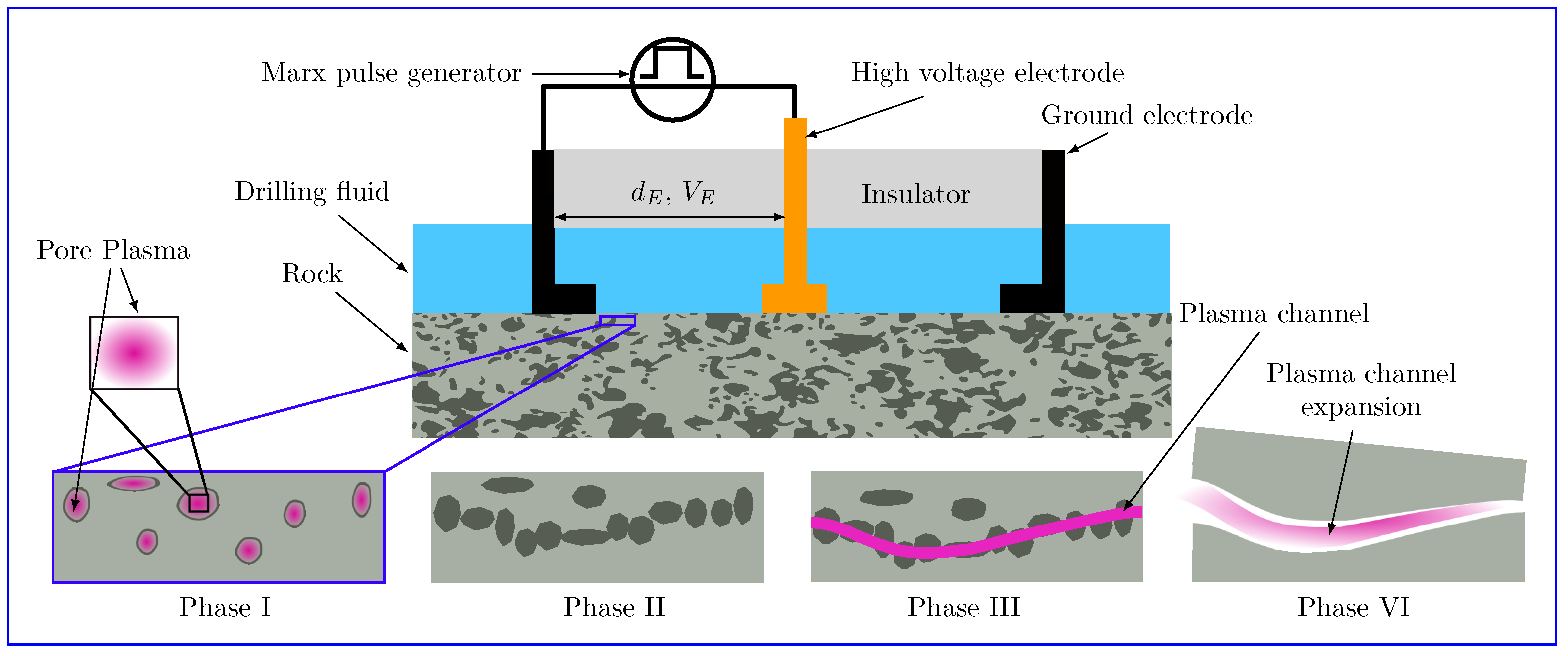
Here, we examine the performance of the PPGD under the deep wellbore conditions (pressure ~ 150 MPa, and temperature ~150C), simulating the 5 km depth. Therefore, we can understand the PPGD behavior under these extreme conditions. We run the experiments in IEG, Fraunhofer (International Geothermal Center, formerly), Bochum, Germany. As a partner, SwissGeoPower AG is the supplies the Marx generator (PULSREX20). Our experimental campaign includes three phases, loading frame experiments, mini i.BOGS experiments, and the i.BOGS experiments. Figure 2 shows a schematic of the first experimental phase, the loading frame.